Projects
We work across different regions of the world, with a particular focus on Europe and Africa. Our research addresses local and regional challenges while maintaining a global perspective. We are always excited to explore and work in new regions.
Project List

RAMANI-Tana – Resource Assessment and Mapping of Agroecosystems and Natural landscapes Initiative for the Tana River Delta
Active
RAMANI aims to support the National Drough Management Authority of Kenya in the development of the Tana Delta Initiative by generating baseline land use/land cover (LULC) indicators through a combination of remote sensing and field surveys of soil properties. The specific objectives are: : (i) to develop high-resolution maps of rangeland and forest cover typologies; (ii) to evaluate rangelands and forests degradation hotspots based on analysis of satellite data time series; and (iii) to devise operations for rangeland/forest monitoring/restoration and climate change adaptation initiatives by establishing baseline indicators of ecosystem status.

VETTA – Enhancing Agro-pastoral Ecosystems and Landscapes in the Bergamo Orobie
Active
The overall objective of the project is to integrate remote sensing, modelling, and digital agriculture methodologies to develop and demonstrate innovative models for the sustainable management of mountain agro-sylvo-pastoral systems in Val Brembana, Italy. Specifically, the project aims to: (i) Reduce environmental risks associated with agricultural and livestock farming practices; (ii) enhance and protect agro-sylvo-pastoral resources, safeguarding soils, landscapes, and biodiversity, while promoting a multifunctional approach to agriculture; (iii) maintain or increase the profitability of agricultural and livestock farms by fostering the efficient and sustainable management of local resources.
NEMESIS: Soil Health Living Labs Network for Combating Desertification and Soil Degradation in the Mediterranean
Active
Nemesis aims to advance soil health in the Mediterranean by building and operating a network of autonomous, community-driven Living Labs that co-design, test, and upscale data-informed and locally grounded solutions, tailored to place-specific challenges and needs, to combat desertification and land degradation, while strengthening soil stewardship through inclusive participation and shared ownership.
Funded by: Horizon Europe
Techgraze – Integrating Advanced Technologies for Enhanced Grazing Practices in Norway
Active
The TechGraze project aims to improve pasture management by integrating Virtual Fencing (VF) and Remote Sensing (RS) technologies. Virtual Fencing allows for dynamic livestock control without physical barriers. Remote Sensing technologies (satellite and drone) allow monitoring of forage availability (quantity and quality) and pasture conditions. The combination of these technologies can provide enhanced strategies for grazing management beyond what either technology could achieve independently.
Funded by: Norwegian Research Council
🔗 Website

HyRELIEF – Enhancing ECOSTRESS drought monitoring with hyperspectral narrowbands
Active
HyRELIEF aims at exploiting hyperspectral narrowbands (HNBs) from Hyperspectral Precursor and Application Mission (PRISMA) to improve evapotraspiration modelling and employ a co-production approach with knowledge users to increase the reliability and usability of ECOSTRESS ET and ESI for drought monitoring in Kenya.
Funded by: European Space Agency
🔗 Website
DaSACaF – Data Science Approach for Carbon Farming Scenarios
Active
The DaSACaF project aims to develop a comprehensive model for evaluating the impact of management, policy and strategic scenarios on carbon sequestration and for optimizing carbon farming practices, keeping into account the trades-offs involved in the decision-making process. DaSACaF explores advanced data science approaches to combine interdisciplinary datasets. methods, and practical knowledge into an innovative modelling framework and decision support system.
Funded by: Fondazione CARIPLO
🔗 Website
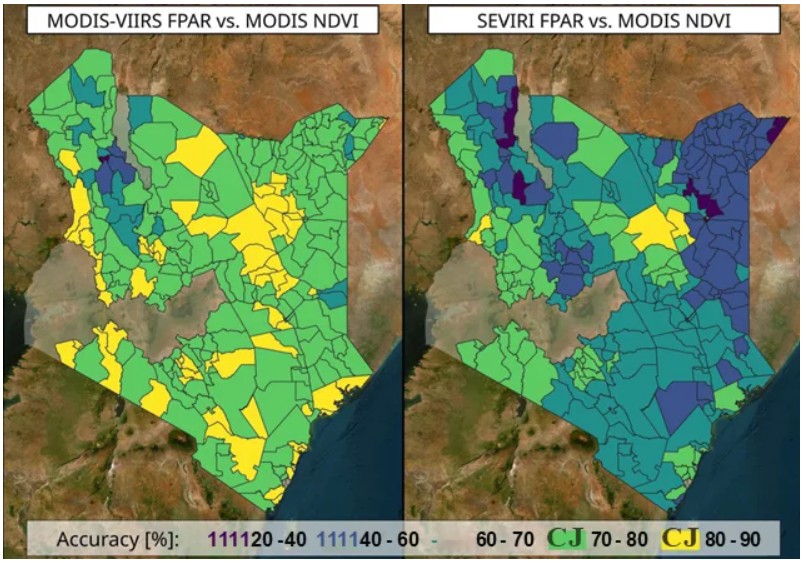
NG’OMBE – Next-generation earth observation for anticipatory drought risk management in East African pastoral drylands
Concluded in December 2025
The NG’OMbE project aims to improve drought early warning and risk financing operational systems targeting pastoral areas in Kenya by addressing a critical challenge they face: the looming lack of a reliable long-term Earth Observation (EO) datasets to assess drought impacts on rangeland production that are the backbone of drought index design. New datasets and analytical methods are being developed to provide reliable alternative for the parametric insurance industry and drought early warning institutions in Kenya.
Funded by: Jameel Observatory
🔗 Website

DTRA-NK
Concluded in December 2025
The DTRA-NK project investigates the spread of vector-borne diseases in arid regions of northern Kenya. These include the Rift Valley Fever Virus (RVFV), the Congo Crimean Hemorrhagic Fever Virus (CCHFV), and the bacterium Francisella tularensis (Ft), which causes the Tularemia disease.
We aim to map the transmission dynamics of these pathogens in diverse ecosystems using geospatial technologies, field data and international collaboration. Here we integrate land use/land cover change analysis with process-based models (DNDC) to assess regional feed balance with different scenarios in the italian Alps. We also contribute to the assessment of drone and hyperspectral technologies for methane emission assessment in Kenyan drylands.
🔗 Website
CIRCAGRIC-GHG
Concluded in December 2025
The overall objective of CircAgric-GHG is to enhance circularity within and between farm typologies across an agro-ecological gradient. The project include farms located in the arctic climate in Norway, via the oceanic climate of UK and Ireland, continental climate of Germany, Mediterranean climate of Spain and Italy to the tropics in Kenya and the dry and temperate climate of South Africa.
Funded by: ERA-Nets SusCrop, FACCE ERA-GAS, ICT-AGRI-FOO and SusAn (Grant N° 696231).
🔗 Website
AGRITECH
Concluded in December 2025
The ‘Agritech’ project: the National Centre for the Development of New Technologies in Agriculture is based on the use of technologies enabling the sustainable development of agrifood production and aims to promote adaptation to climate change, reduce environmental impact in agrifood, develop marginal areas, ensure safety, traceability and typicality of supply chains. We contribute to this project focusing on sub-alpine grasslands in the italian Alps, with the goal of evaluating the latest hyperspectral satellite technologies to estimate pasture productivity and nutritional value.
Funded by: Ministry of University and Research
🔗 Website

BIAN
Concluded in December 2024
By involving producers and technicians in land evaluation processes, our contribution to BIAN seeks to provide tailored recommendations for improving agricultural land management. Furthermore, it supports the creation of bottom-up decision support systems that empower stakeholders to actively participate in decision-making.
Funded by: FIEDS Fondo Italo Ecuatoriano para el Desarrollo Sostenible
🔗 Website